

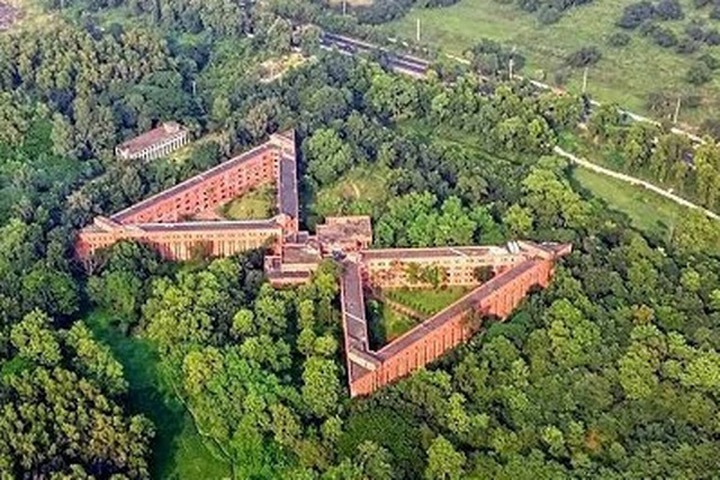
More than a year and a half after Jahangirnagar University appointed a structural expert to advise on the demolition of Mir Mosharraf Hossain (MH) Hall, there has been no visible action to dismantle the building — despite an earlier government directive that placed the hall among dozens of structures to be vacated and removed.
The saga dates back to 12 March 2023, when the Rajdhani Unnayan Kartripakkha (RAJUK) identified MH Hall, built in 1973 and known for its butterfly-shaped design by architect Syed Majharul Islam — as one of 42 buildings in Dhaka and Narayanganj slated to be demolished under an Urban Resilience Project. RAJUK issued notices asking the university to vacate the hall, and the matter later reached the Jahangirnagar syndicate.
In response, the university in a subsequent syndicate meeting appointed Prof. Mehedi Ahmad Ansari, a professor in BUET’s geotechnical engineering department, to study the hall’s condition and recommend action. But 18 months on, students and hall officials say the promised follow-up has stalled and no demolition or substantive safety retrofit has begun.
“RAJUK ordered the hall vacated years ago. Experts were appointed, but we see no activity, no surveys, no notices to residents, nothing concrete,” said Khaled Zubayer Shabab, vice-president of the MH Hall union. He urged the university to either act on the RAJUK directive or immediately reconvene specialists to re-assess the building’s seismic resilience, especially after recent tremors that have unnerved campus residents.
Current wardens and administrators describe a similar disconnect. With the provost reportedly on temporary leave, Warden Prof. Mohammad Mujibur Rahman told reporters the original expert appointment was made by a previous administration and that hall authorities had not been subsequently engaged. He suggested a fresh technical inspection was now overdue even as he noted the hall suffered no major visible damage in a recent earthquake.
MH Hall remains home to more than 500 students, and the building’s cultural and architectural identity – the so-called “butterfly” layout has complicated both public interest and administrative urgency. University officials contacted for comment, including Vice-Chancellor Professor Md. Kamrul Ahsan and Pro–Vice Chancellor Sohel Ahmed, were not immediately available, and the acting registrar, Dr. A. B. M. Azizur Rahman, said he was not fully briefed on the matter because the decision predated his tenure.
Safety advocates and student leaders warn that prolonged inaction undermines confidence in campus governance and places residents at potential risk. They are urging Jahangirnagar University to publish the expert’s report (if completed), share timelines for vacating or retrofitting the hall, and convene a new multidisciplinary assessment that includes seismic specialists and structural engineers.
University insiders say the issue now requires swift, transparent steps: either to implement RAJUK’s demolition order with an orderly relocation plan for residents or to demonstrate, through fresh engineering evidence, that MH Hall can be safely retained after remedial work. Until the administration produces a public roadmap, students who sleep, study and eat inside the flagged building will remain uncertain about their safety and their future accommodation.
Leave a Reply